
Digital purity and danger
Internet vulgarities and moral governance in China

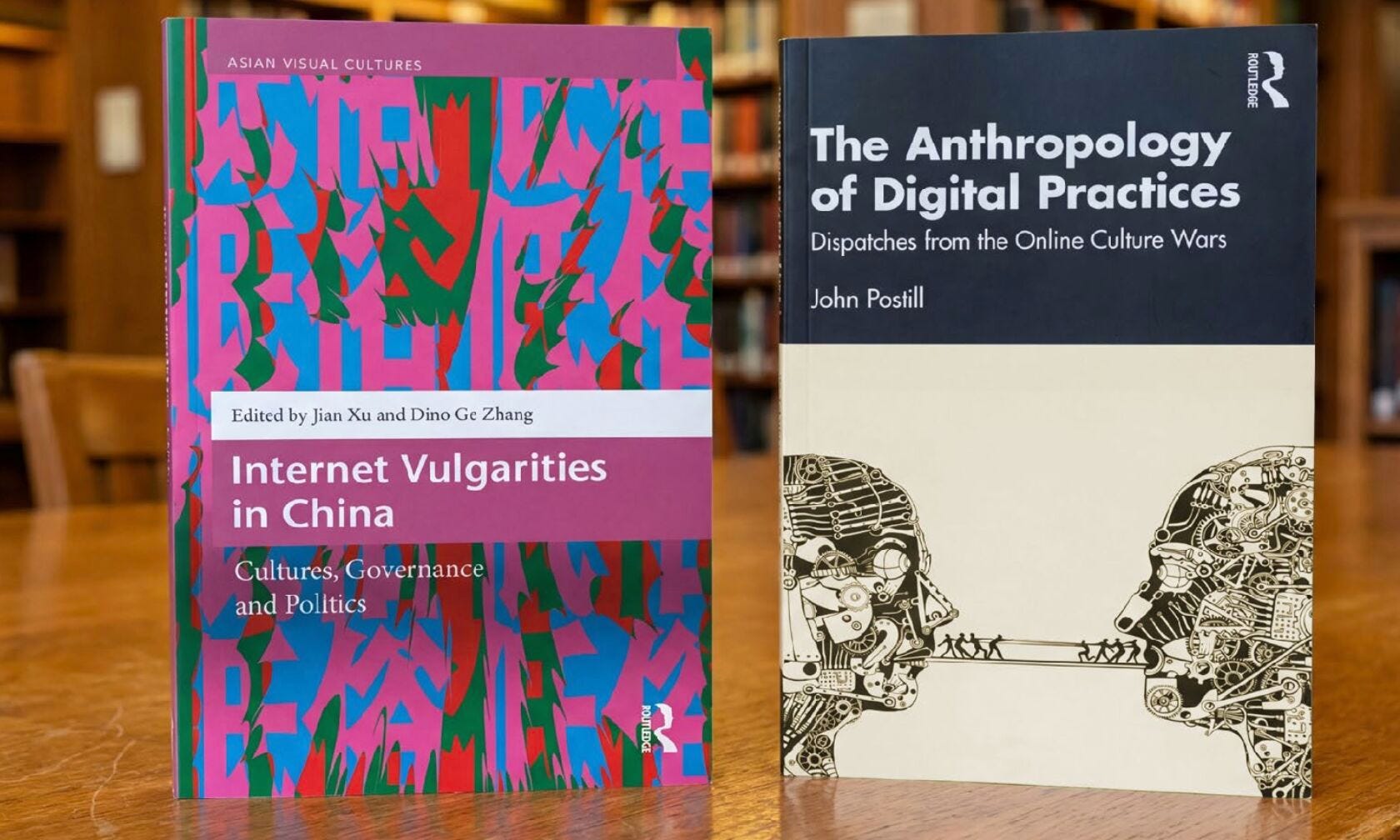
Yesterday I attended an unusual event at Deakin University, in Melbourne: a double book launch (of sorts). The books in question are:
Internet Vulgarities in China: Cultures, Governance and Politics, (co-edited by Jian Xu and Dino Ge Zhang, Routledge, 2026).
The Anthropology of Digital Practices: Dispatches from the Online Culture Wars (by John Postill, Routledge, 2024).
I’ll have plenty to say about my own volume — and its future sequel — in due course, but here are some quick notes about Internet Vulgarities in China while the event is still fresh in my mind.
The co-editors and chapter contributors seem to have struck gold with their chosen topic of internet ‘vulgarities’ (disu, 低俗). As stated in the blurb, the book consists of twelve chapters that explore
the nature, regulation and evolution of the internet cultural products, vernacular internet cultures and subcultural online communities which have been officially deemed ‘vulgar’ by the [Chinese] state, official media and policy documents.
On reading the volume, I was surprised by its coherence. This is no hodgepodge of conference papers, as you sometimes find in edited volumes. Instead, it is a thorough examination of the phenomenon from numerous angles. In his talk, Xu revealed the reason for this consistency: he and Zhang originally designed the book as a monograph.
One issue that jumped out to me during their presentation was the question of pollution. In the early 1980s, the Chinese government launched an ‘Anti-Spiritual Pollution’ campaign. This included denouncing the romantic ballads of the popular Taiwanese singer Teresa Teng as a ‘decadent’ and ‘vulgar’ form of ‘spiritual pollution’ (jingshen wuran, 精神污染) (p. 10).
Another cultural domain of early intervention was television. China’s National Radio and Television Administration’s (NRTA) long-standing concern with vulgarity and pollution is seen in their ‘Cleanse the Silver Screen’ (jinghua yingping, 净化荧屏) campaigns that targeted numerous popular genres (p. 10). In their Introduction, Xu and Zhang note that in China a genre is typically deemed vulgar at the peak of its popularity.
All this made me think of the British anthropologist Mary Douglas’ bestseller Purity and Danger: An Analysis of Concepts of Pollution and Taboo (1966), which I read as an undergraduate decades ago. In Hilary Leathem’s apt summary, Douglas describes hygienic rituals around the world as critical to ‘classificatory systems that revolve around perceptions of ‘dirt’’. She famously defines dirt as ‘matter out of place’. She writes:
[D]irt is essentially disorder. There is no such thing as absolute dirt: it exists in the eye of the beholder…Dirt offends against order. Eliminating it is not a negative movement, but a positive effort to organize the environment.
As Leathem explains, for Douglas dirt is ‘meaningful social residue’. Eradicating it is an act of both symbolic maintenance and worldmaking. Today, she suggests, Purity and Danger remains relevant to historians of science and anthropologists interested in ontology (the study of being and ‘everything that is real’) — especially in ‘the constitution of concepts that govern and order the world today’.
Applying this point about governance and social ordering to internet studies, and to the comparative study of digital cultures more generally, could be fruitful.
Indeed, Xu and Zhang regard the Chinese state’s anti-vulgarity campaigns as a form of governance, of steering the Chinese masses in the right direction, away from the tacky and unsophisticated. In 2014, President Xi Jinping gave a speech where he denounced ‘deviant’ artistic and literary expressions found in China since 1978. He spoke about the inordinate amounts of ‘rubbish’ being produced and sought to recover ‘categorical distinctions between right and wrong, beautiful and ugly’ drawn from a jumble of European and Chinese sources (pp. 28-29).
In the Q&A, Xu said that this emphasis on internet vulgarities appears to be a distinctly Chinese phenomenon, or at least one not found in the West. That may well be the case, but no government exists in a moral vaccuum. Moral questions of online order and disorder, of what Douglas might call digital purity and danger, are unavoidable. These will play out differently in different contexts as state and non-state actors struggle over how to categorise and govern the online world and its offline ramifications.